CNC Machining Metal Parts +86-18169936698
In the modern industrial landscape, the difference between a functioning assembly and a breakthrough innovation often lies in the microns. As engineering disciplines push the boundaries of physics—whether in semiconductor fabrication, medical robotics, aerospace propulsion, or photonics—the demand for components with tolerances measured in single-digit microns has shifted from a niche specialty to a fundamental manufacturing necessity. A high-precision CNC parts manufacturer is no longer merely a vendor of machined components; they are a critical extension of the R&D and engineering departments of the world’s most advanced industries.
To operate in this sphere requires more than a bank of five-axis milling machines. It demands a holistic ecosystem where metrology drives machining, environmental stability is non-negotiable, and the synergy between software, hardware, and human expertise is meticulously orchestrated. This article explores the technical pillars that distinguish a true high-precision manufacturing operation from standard CNC job shops.
Defining the Precision Paradigm
Before delving into methodology, it is essential to define what “high-precision” constitutes in contemporary manufacturing. While standard CNC machining often operates within tolerances of ±0.005 inches (approx. ±127 microns), high-precision manufacturing typically operates in the realm of ±0.0001 inches (±2.54 microns) or tighter. Ultra-high-precision applications—such as fuel injection components, optical housings, or orthopedic implants—frequently demand tolerances in the sub-micron range, alongside stringent requirements for surface finish (often below 8 Ra microinches) and geometric dimensioning and tolerancing (GD&T) controls like flatness, concentricity, and perpendicularity.
Achieving these specifications is not a matter of chance; it is the result of a rigorous, closed-loop system that accounts for every variable in the manufacturing process.
1. The Machine Tool: The Foundation of Mechanical Stability
The cornerstone of any high-precision facility is the machine tool itself. Standard CNC mills and lathes, while capable, often introduce variables such as thermal growth, spindle runout, and backlash that are unacceptable for micron-level work.
High-precision manufacturers invest in machine tools designed specifically for rigidity and thermal stability. This typically involves:
-
Polymer Concrete Bases: Unlike traditional cast iron bases, polymer concrete (mineral casting) offers superior vibration damping—up to ten times that of gray cast iron. This absorption of harmonic vibrations prevents micro-chatter, which can compromise surface finish and tool life.
-
Linear Motor Drives: High-precision machines often eschew traditional ball screws in favor of linear motors. By eliminating mechanical transmission components, linear motors eradicate backlash and hysteresis, providing direct, frictionless motion. This allows for higher acceleration rates with significantly better positioning accuracy.
-
Thermal Management: Heat is the enemy of precision. A machine tool can expand significantly during a production run, altering tool center point (TCP) locations. Advanced manufacturers utilize machines with symmetrical axis layouts, active cooling systems for motors and spindles, and thermal growth compensation software that models and adjusts for heat-induced deviations in real-time.
2. Metrology: The Closed-Loop Imperative
If machining is the action, metrology is the conscience. In high-precision environments, measurement is not an end-of-line quality control step; it is an integrated, in-process function. The mantra is simple: if you cannot measure it, you cannot machine it.
The infrastructure of metrology in a high-precision facility includes:
-
Coordinate Measuring Machines (CMMs): High-accuracy bridge or gantry CMMs, housed in temperature-controlled laboratories (typically 20°C ± 0.5°C), serve as the arbitration standard. These machines use scanning probes to compare physical parts against CAD models, generating detailed reports on form, size, and position.
-
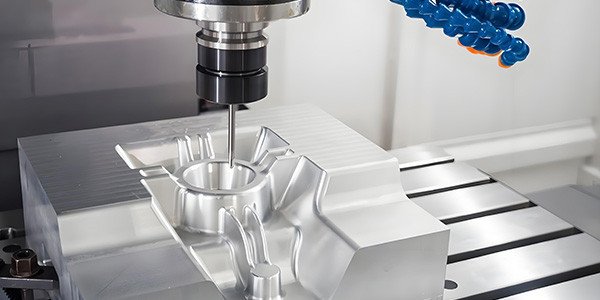
In-Process Probing: Modern high-precision CNC machines are equipped with high-accuracy spindle probes. This serves two critical functions: setup verification (ensuring the stock material is positioned within microns of the digital model) and adaptive machining. In adaptive machining, the probe measures a critical feature mid-cycle; if a deviation is detected, the CAM software dynamically adjusts the toolpaths for the remaining operations to compensate.
-
Non-Contact and Optical Inspection: For complex geometries, micro-features, or delicate surfaces, optical comparators, white light interferometers, and laser scanners are utilized. These tools allow for the rapid inspection of complex contours and edge breaks that are impossible to measure accurately with tactile probes.
3. The Battle Against Thermal Dynamics
Perhaps the most insidious challenge in high-precision CNC manufacturing is thermal growth. Materials expand and contract with temperature fluctuations. A 10°C temperature change in a 300mm aluminum component results in a dimensional change of approximately 0.07mm—a catastrophic deviation in the micron world.
A legitimate high-precision manufacturer controls the thermal environment on three fronts:
-
Facility Climate Control: The production floor is not merely air-conditioned; it is maintained within a strict isothermal envelope, often ±1°C. This includes managing air exchange rates to prevent stratification (temperature differences between the floor and the ceiling).
-
Machine Tool Thermal Stabilization: Before critical machining operations begin, machines undergo a “warm-up” cycle. This involves running the spindle and axes at operational speeds until thermal equilibrium is reached—a process that can take 60 to 90 minutes. Some facilities run critical machines 24/7 to avoid the thermal fluctuations associated with overnight shutdowns.
-
Coolant Temperature Control: High-pressure coolant systems are fitted with thermal control units (TCUs) that regulate the coolant temperature to a precise setpoint, usually slightly below the ambient temperature. This prevents the coolant from acting as a heat-transfer medium that locally heats the part or the fixture during prolonged cutting cycles.
4. Material Science and Tooling Dynamics
The interaction between the cutting tool and the workpiece material is governed by micro-mechanics. In high-precision manufacturing, standard off-the-shelf tooling often falls short.
-
Substrate and Coating: Manufacturers utilize micro-grain carbide substrates that offer higher hardness and edge retention. Coatings such as AlTiN (Aluminum Titanium Nitride) or diamond-like carbon (DLC) are selected not just for wear resistance but for their coefficient of friction and ability to manage heat at the cutting edge.
-
Tool Runout and Balancing: At micron-level tolerances, tool runout (the eccentricity of the tool’s rotation) becomes a primary variable. A tool holder that imparts 5 microns of runout will make it impossible to achieve a 2-micron positional tolerance. High-precision shops utilize hydraulic or shrink-fit tool holders, which offer superior clamping force and concentricity (often under 3 microns) compared to standard collet chucks. Furthermore, tool assemblies are dynamically balanced to G2.5 standards or better to eliminate vibration at high spindle speeds.
-
Chip Control: In precision machining, chip evacuation is critical. Re-cutting chips—where previously cut material passes again through the cutting zone—can cause surface finish defects and micro-welding (built-up edge). High-pressure coolant (often 1,000 PSI or higher) directed precisely at the cutting interface serves to evacuate chips instantly and lubricate the cutting edge, preserving surface integrity.
5. Workholding: The Interface of Accuracy
The machine tool is only as accurate as the interface between the spindle and the part. Workholding is frequently the weakest link in the precision chain. If the part shifts by 10 microns during a tool change, the entire machining strategy collapses.
High-precision workholding strategies include:
-
Zero-Point Workholding Systems: These systems use pull studs and precision ground pallets to ensure that setups are repeatable to within 2 to 5 microns. This allows for parts to be moved from an EDM machine to a mill to a CMM without losing positional reference.
-
Expanding Mandrels and Collets: For turning operations or ID gripping, hydraulic expanding mandrels provide uniform radial clamping pressure. This distributes force evenly around the circumference, preventing the “trilobing” (three-point deformation) effect common with conventional three-jaw chucks.
-
Vacuum and Magnetic Chucks: For thin-walled or non-ferrous components, vacuum chucks or electromagnetic chucks provide uniform clamping force across the entire surface without inducing mechanical stress that could cause the part to “spring” after machining.
6. The Human Factor: Programming and Craftsmanship
Despite the prevalence of automation, the human operator and programmer remain irreplaceable in high-precision environments. There is a distinct difference between CAM programming for production machining and CAM programming for high-precision work.
-
Advanced CAM Strategies: Programmers utilize high-efficiency machining (HEM) or trochoidal milling toolpaths. These strategies maintain a constant chip load and optimal engagement angle, reducing radial forces on the tool. This minimizes tool deflection—a key contributor to inaccuracy—and manages heat generation.
-
Path Tolerance: In standard machining, a CAM post-processor might output code with a tolerance of 0.001 inches. In high-precision work, the chordal tolerance (the deviation between the CAD model and the segmented toolpath) is often set to 0.0001 inches or less, resulting in massive, highly detailed G-code files but ensuring the tool follows the intended geometry exactly.
-
Skilled Trades: High-precision manufacturing relies on a workforce that understands the nuance of “feel.” These machinists interpret surface finishes, listen to spindle loads, and understand the subtle art of tool wear compensation. They are not simply button-pushers; they are process engineers who validate that every variable—from coolant concentration to tool wear offsets—is within the statistical control limits.
7. Quality Management Systems and Traceability
Finally, a high-precision manufacturer operates under rigorous quality frameworks. While ISO 9001:2015 is the baseline, true leaders in the field maintain AS9100D (Aerospace) or ISO 13485:2016 (Medical) certifications.
These frameworks mandate:
-
Statistical Process Control (SPC): Real-time monitoring of manufacturing processes. If a critical dimension begins to trend toward the upper or lower control limit, the process is adjusted before a non-conforming part is produced.
-
Full Traceability: Every bar of material, every cutting tool, and every operator is logged against the serial number of the component. This allows for forensic analysis if a discrepancy arises, ensuring that root causes can be identified and eliminated.
Conclusion
Becoming a high-precision CNC parts manufacturer is a synthesis of advanced physics, meticulous process engineering, and uncompromising quality culture. It requires a shift in mindset from “making parts” to “controlling processes.”
For industries where failure is not an option—where a 5-micron deviation in a fuel injector nozzle reduces engine efficiency by 2%, or where a 10-micron error in a surgical guide compromises a patient’s recovery—the distinction matters. These industries require partners who do not view precision as a target, but as the baseline.
In the modern era of manufacturing, the high-precision CNC manufacturer is not just a supplier; they are the enabler of innovation, turning the theoretical tolerances of CAD models into the tangible, reliable hardware that powers the future. Through the strategic integration of thermally stable machinery, closed-loop metrology, advanced tooling dynamics, and highly skilled craftsmanship, these manufacturers ensure that when the world demands perfection, the machines deliver.
Choose Gazfull CNC Machining Services
At Gazfull, we specialize in providing machining services that go beyond traditional manufacturing. We aim to optimize your processes and reduce production expenses while delivering high-quality results. Our expertise and state-of-the-art 3-axis cutting systems also enable us to handle all your custom needs efficiently and precisely.
For more about high-precision CNC parts manufacturer: the nexus of metrology, machine dynamics, and process control, you can pay a visit to Gazfull at https://www.gazfull.com/services/ for more info.