
CNC Machining for Pharmaceuticals:
Precision Engineering in Drug Development and Manufacturing

Table of Contents
ToggleWhat is CNC Machining?
History and Evolution of CNC Machining in Pharmaceuticals
Applications in the Pharmaceutical Industry
Computer Numerical Control (CNC) machining has become an indispensable technology in pharmaceutical manufacturing. Its ability to deliver micron-level precision, excellent surface finishes, and full repeatability makes it uniquely suited to an industry where patient safety, dosage accuracy, and regulatory compliance are non-negotiable. From the production floor to research laboratories, CNC-machined components ensure that drugs are manufactured, packaged, and delivered with consistent quality. Below are the key areas where CNC machining plays a critical role.
1. Tablet Press Tooling – The Heart of Solid-Dosage Manufacturing
Tablet presses are the workhorses of oral solid-dosage production, and their punches and dies determine the shape, weight, hardness, and appearance of every tablet. CNC machining is the preferred method for manufacturing these tools because tolerances as tight as ±0.005 mm (5 microns) are routinely required.
Upper and lower punches, die tables, and multi-tip tooling are all produced on high-precision 5-axis CNC mills or Swiss-style lathes. Multi-tip punches, which can produce 10–80 tablets per compression cycle, demand perfect alignment of every tip. Even a 10-micron deviation can cause capping, lamination, or weight variation – defects that trigger batch rejection. Advanced CNC programming, combined with toolpath optimization and in-process probing, guarantees identical geometry across thousands of punches.
Special coatings such as chromium nitride (CrN) or diamond-like carbon (DLC) are applied after machining to reduce sticking, especially with hygroscopic or sticky formulations. CNC also enables complex die geometries for bi-layer, tri-layer, and controlled-release, and effervescent tablets. Micro-textured surfaces or laser-etched logos – once impossible with conventional tooling – are now standard, improving both functionality and brand identification.
2. Packaging and Filling Equipment
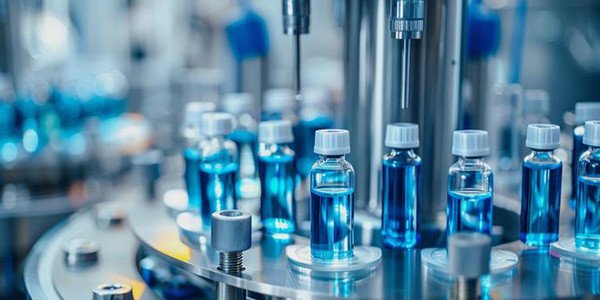
Aseptic filling lines, blister-pack machines, bottle cappers, and labeling systems contain hundreds of precision components that must withstand aggressive cleaning agents, maintain sterility, and deliver exact fill volumes. CNC machining produces:
- Filling nozzles and needles for syringes, vials, and cartridges
- Change parts for rapid format changeovers
- Star wheels, screws, and guides in high-speed conveyors
- Sealing jaws and crimping tools for ampoules and injectables
For viscous products such as creams, gels, or biologics, custom nozzle geometries are machined from 316L stainless steel or Hastelloy to optimize shear rates and prevent clogging. Surface finishes below Ra 0.4 µm, achieved through precision grinding and electropolishing after CNC milling, are mandatory to eliminate microscopic pits where bacteria could hide. In many cases, these parts are validated as “product-contact” components and must carry full material traceability and surface-roughness certification.
3. Laboratory and Process Development Equipment
During drug development and scale-up, laboratories rely heavily on CNC-machined parts:
- Centrifuge rotors and buckets that spin at 20,000+ rpm without vibration
- Precision impellers and baffles for bioreactors and mixing vessels
- Microfluidic chips and lab-on-a-chip devices for high-throughput screening
- Custom molds for prototype capsule shells, orally dissolvable films (ODF), and transdermal patches
Because R&D batches are often small and formulations change frequently, CNC’s ability to produce one-off or low-volume parts overnight provides a dramatic speed advantage over traditional tooling methods.
4. Drug Delivery Devices and Medical Components
Modern drug delivery systems demand extreme precision:
- Auto-injectors and pen injectors: plungers, needle shields, and dose dials machined to sub-10-micron tolerance for reliable activation force
- Inhalers (DPI, pMDI, soft-mist): swirl chambers, nozzles, and valve stems that control particle size distribution and lung deposition
- Implantable drug pumps and ports: titanium or PEEK housings with complex internal channels
- Wearable injection devices: miniature gears and cams produced on micro-CNC machines
In biologics and gene-therapy manufacturing, CNC-machined single-use bioreactor fittings, tubing adapters, and sanitary tri-clamps ensure leak-proof, sterile connections.
5. Automation and Robotics in Pharma Plants
Industry 4.0 initiatives have accelerated the deployment of robotic systems for vial inspection, syringe assembly, and palletizing. These robots depend on lightweight, high-strength components – typically aluminum 7075 or titanium – that only CNC machining can produce economically at the required precision. Custom end-of-arm tooling (EOAT), grippers, and sensor mounts are designed, programmed, and machined in days rather than weeks, enabling rapid line reconfiguration for new products.
6. Specialized and Emerging Applications
- Effervescent and controlled-release tooling with laser-ablated micro-channels for precise gas escape or diffusion control
- Micro-texturing of die surfaces to reduce punch sticking by up to 70 %
- 3D-contoured punches for shaped tablets (hearts, animals, etc.) used in pediatric or veterinary medicines
- Ceramic (zirconia or alumina) tooling for highly abrasive direct-compression formulations
The shift toward continuous manufacturing (CM) further elevates CNC’s importance. Continuous tablet lines require feed frames, die discs, and compression rollers with virtually zero runout. Any eccentricity translates directly into weight variation, making CNC the only viable manufacturing method.
CNC machining is far more than a supporting technology in pharmaceuticals – it is an enabling technology that touches virtually every stage of drug development and production. From multi-tip punches that define tablet uniformity to microfluidic prototypes that accelerate discovery, CNC delivers the precision, repeatability, and material versatility that regulatory bodies demand. As the industry moves toward personalized medicine, continuous manufacturing, and complex biologics, the role of CNC will only grow. Manufacturers who master advanced CNC techniques – including 5-axis simultaneous machining, in-machine metrology, and digital-twin validation – will gain significant competitive advantage in speed, quality, and compliance.
In an environment where a single defective component can cost millions in recalls or lost batches, CNC machining remains the gold standard for turning stringent pharmaceutical requirements into reliable, repeatable reality.
Materials Used in CNC Machining for Pharmaceuticals
Benefits of CNC Machining for Pharmaceuticals
Challenges in CNC Machining for Pharmaceutical Manufacturing
Despite its advantages, CNC machining in pharmaceuticals presents several challenges. Regulatory compliance is paramount; parts must undergo rigorous validation, which can extend timelines and increase costs. Maintaining sterility during machining requires cleanroom environments and specialized tooling to avoid contamination.
Tight tolerances pose technical hurdles. Achieving micron-level precision while managing heat generation—which can warp materials—is difficult, especially with heat-sensitive alloys. Complex geometries, like undercuts or deep cavities, limit tool access and demand advanced multi-axis machines.
Supply chain issues, exacerbated by global events, affect material availability and lead times. High-volume production challenges include ensuring consistency amid wear on tools, requiring robust quality control.
Material-specific problems, such as sticking or chipping in pharma tooling, impact yields. Additionally, integrating CNC with other technologies like AI demands skilled operators, addressing workforce gaps.
Overcoming these involves innovation in cooling systems, software, and training, ensuring CNC remains viable for pharma.